Las Vegas Car Accident Lawyer in Nevada

Free Confidential Consultation for Human Trafficking Victims
Free Confidential Consultation for Human Trafficking Victims
A Las Vegas car accident lawyer at THE702FIRM Injury Attorneys can step in before an insurance adjuster shapes the claim around the company’s interests. If you were hurt in a Las Vegas car accident, you may be facing medical treatment, missed work, and questions about who will pay. Nevada follows an at-fault system, so the person or business whose negligence caused the crash may be responsible for the resulting losses. The insurer will still demand proof of fault, injuries, and damages.
We represent injured people in Las Vegas, NV, and handle claims from investigation through settlement talks or, when needed, a personal injury lawsuit. Our legal team can preserve evidence, identify available insurance coverage, document medical bills and lost wages, and protect you from pressure to accept an early offer. These services are part of our broader work in Nevada personal injury cases.
Call us for a free consultation. You will learn what to do next and whether legal representation is the right decision for your case.
People looking for a car accident attorney in Las Vegas need practical guidance, steady communication, and a case strategy built around the actual evidence. THE702FIRM Injury Attorneys is a local personal injury law firm. We understand the roads, courts, medical providers, and insurance issues that can affect an injury claim in Southern Nevada. This local focus helps us act quickly when footage, vehicles, or witnesses may be hard to locate later.
We prepare every matter with litigation in mind, even when we may reach a fair resolution without filing suit. Trial readiness is not a promise about the result. It means the file should be supported by admissible evidence, complete damage records, and a clear account of how the crash changed your health and work.
An experienced car accident attorney helps organize the legal process. We start by listening to your story and reviewing the information you have. Next, we investigate the accident, identify everyone who may be responsible, and determine which insurance policies could apply. Sometimes, this means finding coverage from an employer, vehicle owner, rideshare company, or other sources besides the at-fault driver’s policy.
No lawyer can promise a specific result or the highest possible compensation. We can promise to work hard, meet deadlines, review the evidence carefully, explain your options, and recover compensation based on the facts.
Our Las Vegas car accident attorneys help with almost every kind of motor vehicle accident, whether it happens on city streets, highways, or in parking lots. Here are the types of crashes we see most often, the legal issues they bring, and how we handle them.

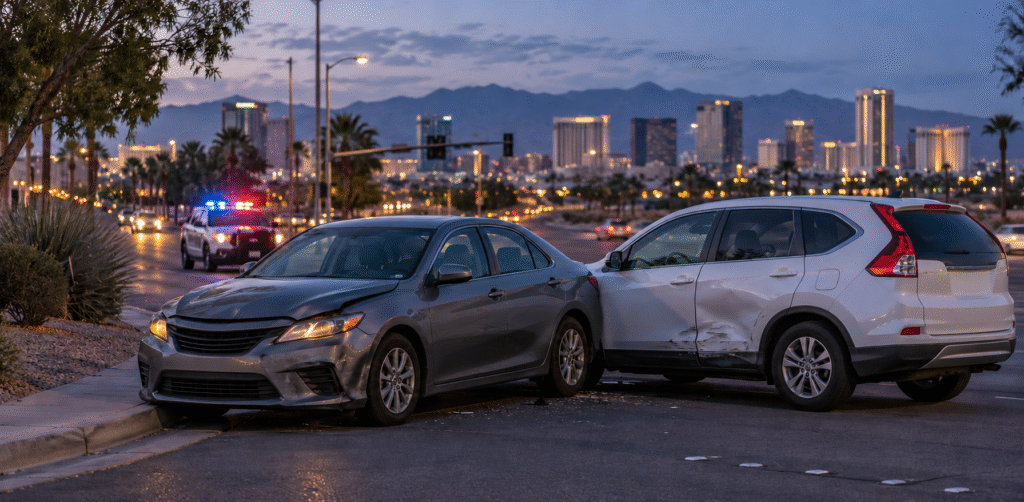
Rear-end collisions may involve following distance, traffic speed, sudden stops, or a chain reaction. Vehicle damage and medical findings can help show the force and direction of impact.

Head-on crashes often require a close review of lane position, roadway markings, impairment, and available video because the injuries can be severe.

T-bone and side-impact collisions commonly raise questions about right of way, turn signals, traffic lights, stop signs, and sight lines at an intersection.

Rollover and single-vehicle crashes may involve another vehicle’s actions, road conditions, a defective component, or a driver’s own conduct. A single-vehicle crash is not automatically a case with no responsible third party.

Multi-vehicle accidents can produce competing accounts and several insurance claims. Evaluate each impact and each driver’s share of fault separately.

Hit-and-run crashes require quick efforts to locate video, witnesses, debris, and identifying information. Uninsured-motorist coverage may also become important.

Drunk-driving, distracted-driving, and drowsy-driving cases require proof of conduct, not assumptions. Phone records, toxicology evidence, receipts, admissions, or driving patterns may be relevant when lawfully obtained.

Rideshare and taxi crashes may involve personal and commercial policies. The driver’s app status, passenger status, employer relationship, and trip records can affect which coverage applies.
Collisions with commercial vehicles raise separate questions about carrier records, driver qualification files, and federal safety rules. Those matters are handled as truck accident claims.

Fatal crashes may support a wrongful death claim for eligible family members or the estate. These matters need careful handling of financial losses, final medical expenses, and the human loss recognized by Nevada law.
Your first priorities are safety and medical attention. If you are able, these six steps can also preserve information that may matter later.
Nevada’s at-fault system begins with negligence. A claimant generally must show that another person or business failed to use reasonable care and caused compensable harm. NRS 41.130 states the general rule that a person who causes injury through a wrongful act, neglect, or default is liable for the resulting damages, subject to other Nevada law.
Fault is not always all or nothing. Nevada uses a modified comparative negligence rule under NRS 41.141. An injured person may recover when their share of negligence is not greater than the combined negligence of the defendant or defendants. In practical terms, recovery is barred at 51% fault. When recovery is allowed, the award is reduced by the injured person’s percentage of fault. For example, a finding of 20% fault reduces recoverable damages by 20%.
Insurance limits can shape the available recovery even when liability is clear. NRS 485.185 requires most registered Nevada vehicles to carry at least $25,000 in bodily-injury liability coverage for one person, $50,000 for bodily injury to two or more people in one crash, and $20,000 for property damage. These 25/50/20 minimums may be inadequate after serious injuries.
When the at-fault driver has no insurance or too little coverage, uninsured or underinsured motorist coverage under your own policy may apply. Other possibilities can include a household policy, employer coverage, rideshare coverage, or an umbrella policy, depending on the facts and policy terms. A coverage review should happen early because notice and cooperation duties may apply.
A useful estimate usually becomes possible after the lawyer understands the liability evidence, available coverage, course of treatment, work loss, and medical outlook. Valuing the claim too early can miss surgery, rehabilitation, or lasting restrictions. The goal is a documented range based on the file, not a number chosen to persuade you to hire a firm.
Nevada’s deadline for an injury lawsuit is two years, but the correct date can depend on the car accident claim and the parties. Sending documents to an adjuster is not the same as filing a lawsuit. Ask an attorney to calendar the deadline and check for any shorter notice rule or statutory exception.
Notify your own insurer promptly and ask for the complete policy, including declarations and endorsements. UM coverage may respond to an uninsured or hit-and-run driver; UIM coverage may apply when liability limits are too low. A lawyer can also check household, employer, rideshare, and umbrella policies before concluding there is no further coverage.
Report the collision to your own carrier as your policy requires, but keep the account factual and do not guess. Before giving the other driver’s insurer a recorded statement or signing medical authorizations or a release, get legal advice. Your policy may require cooperation, so don’t ignore requests; ask what information is needed and why.
A bodily-injury claim and a property-damage claim are related, but insurers usually evaluate them separately. The property claim may include reasonable repair costs, towing and storage, loss-of-use or rental expenses, personal items damaged in the vehicle, and the vehicle’s value if it is declared a total loss. Policy language and the facts determine what is covered.
Protect the claim by taking clear photographs before repairs, keeping every estimate and invoice, and asking the adjuster to explain a valuation in writing. For a total loss, review the listed trim, mileage, options, pre-crash condition, and comparable vehicles. If repairs leave a newer vehicle worth less than it was before the collision, you may be able to file a diminished-value claim. Do not sign a broad release without confirming whether it affects only property damage or also the injury claim.
Our legal team can coordinate with the carrier about repair estimates, rental needs, salvage questions, and missing items in the valuation while the medical side of the case continues. That coordination helps prevent a vehicle issue from being overlooked or confused with compensation for physical injuries.
A collision can injure the brain, spine, joints, bones, skin, or internal organs. Some car accident victims need a short course of care. Others require surgery, rehabilitation, extensive medical treatment, or long-term support. Only a qualified medical professional can diagnose an injury and recommend care.
Consistent medical attention creates a record of symptoms, diagnosis, treatment, progress, and future needs. It also helps the legal team understand whether a condition affects work, sleep, mobility, family responsibilities, or quality of life.
No responsible car accident lawyer can value a case from a short online description or promise a specific result. A fair assessment develops from records, liability evidence, insurance information, and the medical outlook. Online calculators and simple multiples rarely capture those details.
Economic damages may include past and future medical expenses, lost wages, reduced earning capacity, property damage, and other necessary out-of-pocket costs. Non-economic damages address physical pain, emotional distress, loss of enjoyment of life, scarring, and the effect of a lasting impairment. A wrongful death case involves a different set of losses under Nevada law.
The strength of the proof matters as much as the type of loss. Key factors include injury severity, the length and consistency of medical treatment, future care needs, whether the crash caused or worsened the condition, the clarity of liability, any comparative fault, witness credibility, the effect on employment, and the amount and type of insurance coverage. Liens or reimbursement claims can also affect the amount an injured person ultimately receives.
We evaluate a car accident case only after reviewing the available evidence. That approach supports a demand for fair compensation without setting expectations the facts cannot support.
The general deadline to file a Nevada lawsuit for injuries or death caused by another person’s wrongful act or neglect is two years. NRS 11.190 states that limitation period, but exceptions or different notice rules may apply. Review a car accident claim involving a public entity, a minor, a defendant who cannot be located, or another unusual fact promptly, and confirm the filing deadline for a Nevada crash claim. An insurance negotiation does not automatically extend the filing deadline.
A separate crash-reporting rule may also matter. Under NRS 484E.070, a driver must send the Nevada DMV a report within 10 days when a crash causes bodily injury, death, or apparent damage of at least $750. The statute includes an exception when a police officer investigated and the officer’s report contains the required insurance information, including the insurer’s name and address, the policy number, and the coverage dates. Confirm the requirement for your situation instead of assuming the police report resolved it.
Do not wait for the two-year mark. Video can be erased, vehicles can be repaired, and witnesses can become harder to find. Early investigation protects evidence even if medical recovery takes much longer.

You do not need a complete file before you ask for help. Bring what you have: the police report number, photographs, insurance details, medical paperwork, repair estimates, and any messages from an adjuster. We can identify what is missing and explain the next practical step. Call THE702FIRM Injury Attorneys or request a free case evaluation. If we take your Las Vegas car accident case, we don’t take a fee unless we win.